
In many homes, a water heater leak is dismissed as “just a drip.” In Dubai, this mindset is risky. Because of desalinated water, high mineral content, extreme heat, and ceiling-mounted installations, leaks often escalate faster and cause more damage than homeowners expect.
A water heater leak is rarely a random failure. It’s usually the final symptom of internal stress that has been building silently for years.
Dubai’s Hidden Risk #1: Desalinated Water & Aggressive Scaling
Most homes in Dubai rely on desalinated water, which often carries high levels of calcium and magnesium.
Why this matters:
- When water is heated, these minerals settle inside the tank
- Over time, they harden into limescale
- Limescale traps heat against metal surfaces
The real danger:
This trapped heat causes the tank to:
- Expand and contract more aggressively
- Overheat heating elements
- Develop micro-fractures in the tank lining
Result:
Many water heaters in Dubai start leaking much earlier than expected, sometimes within 3–5 years, even if the unit looks fine from the outside.This is why leaks in the UAE often appear “suddenly,” when the damage has actually been happening quietly for years.
Dubai’s Hidden Risk #2: Ceiling-Mounted Water Heaters
In apartments and villas, water heaters are commonly installed:
- Above false ceilings
- Inside gypsum service panels
- In ceiling trays hidden from view
Why ceiling leaks are dangerous:
- Water collects above gypsum boards
- Damage remains invisible for days or weeks
- Ceilings weaken silently
- Collapse can happen suddenly
By the time a stain appears, the damage is already advanced.
Practical insight:
A leaking water heater above a ceiling can:
- Destroy ceilings
- Damage furniture and electronics
- Lead to mold inside the walls
- Affect neighboring apartments
This is why early detection matters more in Dubai than in ground-mounted installations.
The “Summer Pressure Trap” Unique to the UAE
Dubai’s extreme summer heat creates a unique pressure scenario inside water heaters.
What happens in summer:
- Ambient temperatures exceed 45°C
- Tank pressure increases even when the heater is idle
- Water inside solar and electric heaters heats further due to the surroundings
Where leaks start:
If the Temperature & Pressure (T&P) relief valve:
- Is blocked by mineral scale
- Is it jammed or poorly maintained
Then the pressure has nowhere to escape.
The result:
- Valves fail
- Fittings weaken
- Tank seams rupture
- Sudden leaks or violent water discharge occur
This is one reason leaks often appear after summer, even though the heater wasn’t heavily used.
Brown or Rusty Water: The Leak That Hasn’t Started Yet
When homeowners notice brown or rusty water from hot taps, it’s often ignored.
What it actually means:
- The sacrificial anode rod is fully consumed
- Tank steel is now corroding directly
Rust flakes are entering the water supply
Dubai-specific insight:
In local water conditions, anode rods can fail in as little as 2 years.
Once brown water appears:
- Tank corrosion is already advanced
- Structural integrity is compromised
- A leak is often weeks or months away, not years
At this stage, repair rarely makes sense.
Leak Source Matters: Not All Water Heater Leaks Mean the Same Thing
Understanding where the leak comes from helps determine urgency.
1.Top of the tank:
Usually caused by:
- Loose inlet/outlet fittings
- Anode rod ports
- Pipe connections
Often repairable if addressed early.
2.Side of the tank (T&P valve):
Signals:
- Over-pressurization
- Faulty valve
No expansion control
This is a safety-critical issue and should never be ignored.
3.Bottom of the tank:
Most dangerous sign, Usually caused by:
- Internal corrosion
- Cracked tank liner
- Structural failure
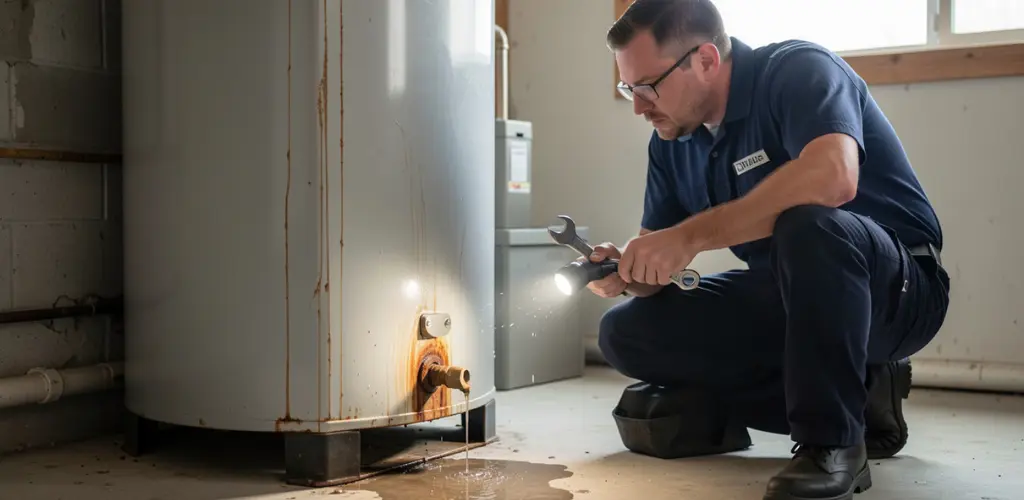
Once water seeps from the tank base, replacement is the only safe option.At this stage, repair is no longer safe. Homeowners typically need to replace the water heater with a unit suitable for Dubai’s water conditions and installation style. It’s better to review water heater specifications and replacement options before a sudden failure occurs.
Financial Reality: Small Leaks, Big Costs
Even a slow leak can:
- Waste thousands of liters annually
- Increase energy bills due to constant reheating
- Cause hidden water damage
- Trigger mold remediation costs
In Dubai, repair costs escalate quickly because:
- Ceiling damage requires skilled labor
- Water damage often affects multiple rooms
- Insurance may not cover neglect-related failures
Preventive Maintenance That Actually Works in the UAE
Generic advice doesn’t always apply here, These steps matter locally:
- Quarterly partial flush (5–10 liters) to reduce scale
- Anode rod inspection every 2 years
- T&P valve testing every 6 months
- Accessible isolation valve for emergency shutoff
- Leak sensors in ceiling trays, especially in apartments
- Temperature settings around 49°C to reduce pressure stress.
These steps don’t eliminate water heater leaks—but they delay them significantly and reduce damage.